

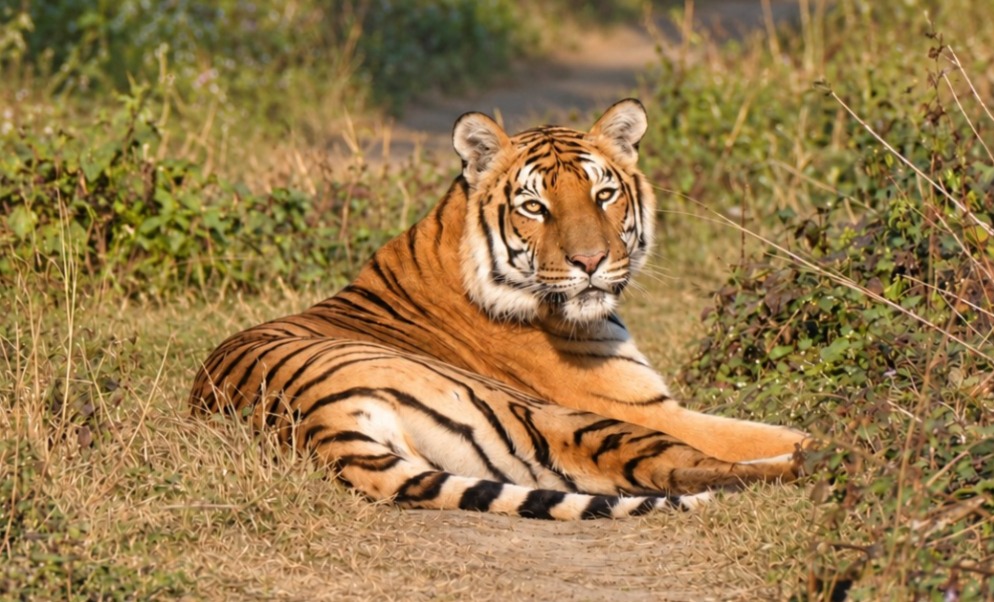
Bengal Tiger |पाटे बाघ (PATE BAGH)
The Bengal tiger is one of Nepal’s most iconic and ecologically important species. As the dominant predator of the country’s lowland forests and grasslands, it plays an essential role in maintaining healthy ecosystems. Tigers also hold considerable cultural, conservation and economic importance.
The Bengal tiger (Panthera tigris tigris) is a tiger population native to the Indian subcontinent and one of the largest wild cats in the world. It occurs mainly in India, Nepal, Bangladesh and Bhutan, inhabiting tropical and subtropical forests, mangroves and tall grasslands.
In Nepal, tigers are found primarily across the Terai Arc Landscape. As apex predators, they help regulate prey populations and maintain the ecological balance of the landscapes in which they live.
Species of Big CatBengal tigers inhabit tropical and subtropical broadleaf forests, dry deciduous forests, riverine forests and tall alluvial grasslands. In Nepal, they occur mainly in the lowlands, although individual tigers have occasionally been recorded at higher elevations. Nepal’s main tiger populations occur in and around Chitwan, Parsa, Banke, Bardia and Shuklaphanta National Parks. Wildlife corridors and community forests between protected areas are also important because they allow tigers and other wildlife to move, disperse and maintain connections between populations. Nepal’s fifth National Tiger Survey estimated 429 wild tigers in 2026, an increase from 355 in 2022. Globally, approximately 5,574 tigers are estimated to remain in the wild, with India supporting the largest population.
Bengal tigers are generally solitary and territorial. They usually come together only to mate or when a female is raising her cubs. Males occupy large home ranges that may overlap with those of several females but rarely with those of other adult males.
Tigers communicate and mark their territories using scent, scrapes, visual signs and vocalizations, including roars, growls and close-range chuffing sounds. They are mainly active at dawn, dusk and during the night, although their activity patterns vary according to prey availability, human disturbance and local environmental conditions.
Tigers depend on stealth and a short, powerful chase to capture prey. Their principal prey species include sambar, chital or spotted deer, wild boar and gaur. They may also prey on smaller wildlife or livestock when natural prey is scarce or when livestock is accessible near tiger habitats.
Tigers reach sexual maturity at approximately three to four years of age. After a gestation period of around 100 to 105 days, a female generally gives birth to two to four cubs. The cubs are born blind and remain entirely dependent on their mother during their early development.
Young tigers usually remain with their mother for approximately 18 months to two years, during which they learn to hunt and survive independently. In the wild, tigers generally live for around 10 to 15 years. Unlike many other cats, they are powerful swimmers and readily cross rivers and other bodies of water.
Tigers are both flagship species and indicators of healthy ecosystems. Protecting tigers requires conserving extensive forests and grasslands, maintaining wildlife corridors and safeguarding adequate populations of natural prey. These measures also benefit numerous other plants and animals living within the same landscape.
By regulating populations of deer, wild boar and other herbivores, tigers help maintain vegetation and ecological balance. The presence of breeding tigers can therefore indicate that a landscape contains sufficient habitat, prey and ecological connectivity.
The tiger is classified as Endangered on the IUCN Red List. It is also included in CITES Appendix I, which prohibits international commercial trade in tigers and their body parts. In Nepal, the tiger is protected under the National Parks and Wildlife Conservation Act 2029 (1973).
Despite these protections, tigers remain threatened by habitat loss and fragmentation, declining prey populations, illegal hunting and trade, infrastructure development and human–tiger conflict.
As tiger populations and ranges recover, interactions between people and tigers require increasing attention. Livestock predation and encounters near settlements can cause economic losses and create serious safety concerns for communities living around tiger habitats.
Long-term tiger conservation therefore depends on protecting both wildlife and people.
• No two Bengal tigers have exactly the same stripe pattern. Researchers use these unique patterns to identify individual tigers from camera-trap photographs.
• Tigers are strong swimmers and can cross rivers and other bodies of water while moving through their territories.
• A tiger’s roar can be heard from several kilometres away and helps it communicate across a large area.
• A tiger can consume more than 30 kilograms of meat during a large meal and can drag prey heavier than its own body.
• Tigers require large, connected habitats containing adequate natural prey, water and secure breeding areas.
BIOCOS Nepal works to understand human–tiger interactions and develop practical conservation responses that protect both tigers and communities. Our work currently focuses on landscapes surrounding Chitwan, Banke and Bardia National Parks and the Khata wildlife corridor.
We conduct field assessments and household surveys in communities affected by human–tiger conflict. This research documents tiger encounters, livestock losses, threats to human safety, compensation experiences, dependence on forest resources and local attitudes towards tiger conservation.
The findings help us identify conflict-prone locations, vulnerable households and gaps in protective infrastructure and existing response mechanisms.
Link to Research Program
We work with local communities to strengthen awareness of tiger behaviour, personal safety, conflict reporting and appropriate responses during tiger encounters.
Based on research findings and community consultation, BIOCOS Nepal is developing practical measures that may include:
• Tiger-safety education and improved conflict reporting
• Predator-resistant livestock corrals
• Protective fencing for particularly vulnerable households
• Support for alternative fodder and energy sources to reduce risky forest visits
• Livelihood opportunities linked with conservation
• Improved coordination among communities, protected-area authorities and local governments
Link to Conservation Education
Our goal is to reduce risks to people and livestock while maintaining community support for tiger conservation. Effective coexistence requires locally appropriate solutions, timely responses to conflict incidents and fair access to compensation and other forms of support.
BIOCOS Nepal promotes conservation approaches that recognise the knowledge, concerns and priorities of people living alongside tigers.
BIOCOS Nepal is exploring the carefully controlled use of cameras, sensors and other technologies to detect tiger movements near vulnerable settlements.
Any future early-warning system would first be tested through a limited pilot programme. Alerts would be provided only to authorised government personnel, trained community scouts and designated community representatives to avoid disturbance, misinformation or misuse of sensitive wildlife-location data.
Protecting Bengal tigers means protecting the forests, grasslands, rivers, prey species and wildlife corridors on which they depend. It also means supporting the safety, livelihoods and participation of communities sharing these landscapes.
Through scientific research, community partnership and practical field action, BIOCOS Nepal is working towards a future in which people and tigers can coexist across Nepal’s lowland landscapes.