

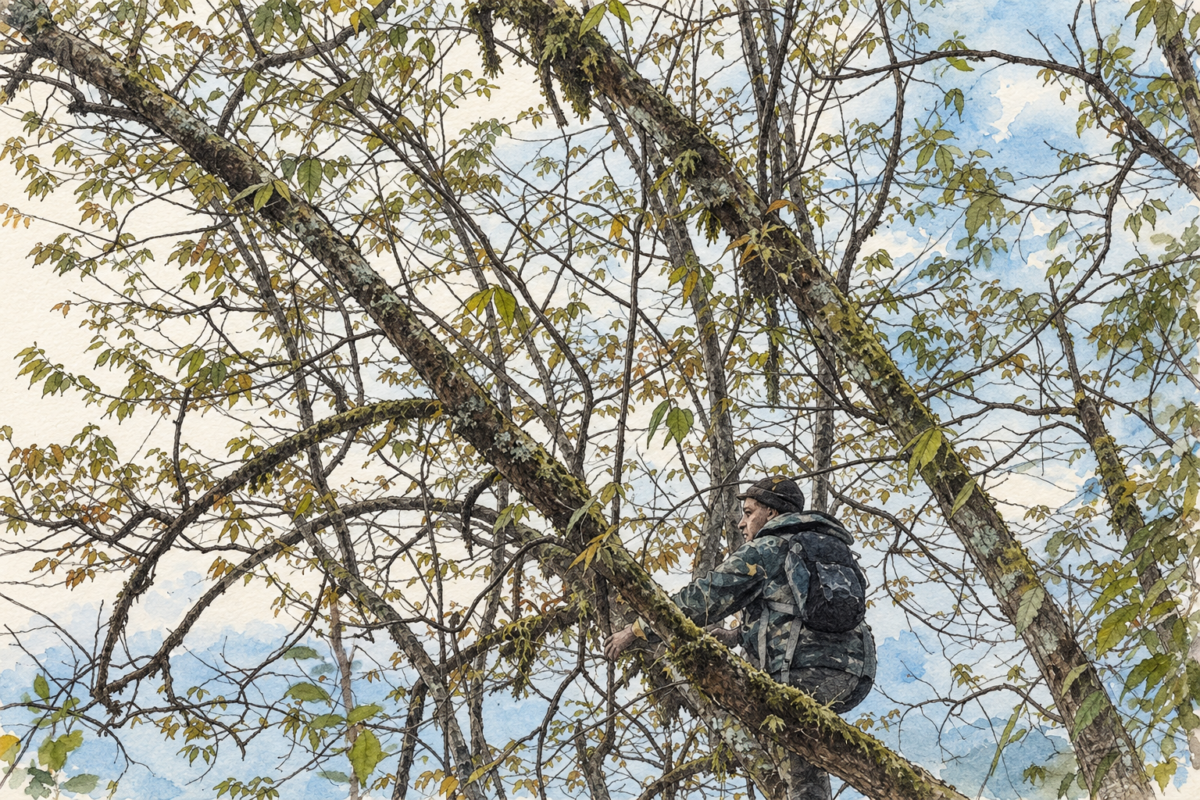
Pawan Rai/BIOCOS-Nepal
Before the sun rises over the forests below Mt. Machhapuchhre, the landscape is almost completely dark. The survey team leaves camp early and walks quietly towards fixed listening points. At this hour, seeing a pheasant among the rhododendron, bamboo and steep slopes is difficult. Listening, however, can reveal what the forest holds. A call from one ridge, followed by another from a different direction, helps the observers estimate how many birds are present.
This is the basis of the Spring Count in the Pipar Pheasant Conservation Landscape, or PPCL. The landscape includes Pipar, Khumai, Korchan and Santel within the Annapurna Conservation Area. Pipar has been known for its pheasants since the 1970s, and systematic monitoring began in 1979. The continuation of the count allows us to compare the present condition of the birds with records collected over more than four decades. Scarcely any places in Nepal have such a long history of monitoring Himalayan pheasants.
The 2025 survey was conducted between 17 and 30 April in the Pipar and Khumai forest blocks. In Pipar, the team worked at Pilicho, Pipar Bowl and Pipar Kharka, between about 2,700 and 3,400 metres. In the broader Khumai forests, the survey covered Chichimle, Luburjung, Khumai, Meshram and Korchan, extending from about 2,400 to 3,700 metres.
Ten established listening stations were used in Pilicho and Pipar: four at Pilicho and six at Pipar. These stations are especially important because using the same places makes the new observations comparable with historical counts. To extend monitoring into the wider landscape, 13 new listening stations were established across the Khumai forests. Altogether, the 2025 Spring Count used 23 listening stations. Counts were completed over six mornings in Pipar and fourteen mornings in Khumai.
The method is simple in appearance but requires preparation, discipline and experience. Observers reach their predetermined listening stations before dawn and remain quiet while the birds begin calling. During the 2025 count, calls were recorded from 04:45 to 05:30. This short period is important because pheasants are most vocally active around dawn, while the forest is still relatively quiet.
For every call, observers record the species, time, and direction. The team listens carefully to judge whether calls come from the same bird or from different individuals. Timing and direction are then compared between nearby stations so that one bird heard by two teams is not counted twice. The result is a minimum number of calling birds rather than an exact total population. Most of the recorded callers are males, and birds that remain silent cannot be included.
The work continues after the listening period. Team members compare their field notes, discuss calls heard between stations, and check possible duplicate records. They also record other birds encountered during the survey. During the 2025 work, habitat information was added through remote mapping, field verification, and discussions with local people familiar with the forests. Calls, sightings, feathers, droppings, and local knowledge helped the team refine potential habitat areas for Satyr Tragopan, Hill Partridge, and Koklass Pheasant.
The most interesting part of a Spring Count is that each morning is different. A slope that seems silent one day may become active the next. Calls may come from across a valley, from thick bamboo below a trail or from a ridge hidden by cloud. The observer must separate direction, distance and timing while working in cold, low light and difficult terrain. The survey is therefore both a scientific exercise and a close experience of the mountain forest at its most active hour.
Three focal Galliformes were regularly detected in 2025: Satyr Tragopan, Hill Partridge and Koklass Pheasant. Himalayan Monal calls were also heard occasionally. The minimum count on a single morning reached 68 calling male Satyr Tragopans across the 13 Khumai stations and 32 across the 10 Pipar stations. For Hill Partridge, the corresponding minimum counts were 45 in Khumai and 20 in Pipar.
The long-term comparison gives these numbers their meaning. Satyr Tragopan remained broadly stable at the historical Pipar stations, showing the continuing value of protected forest. Hill Partridge increased at the six Pipar stations from seven birds in 2022 to fourteen in 2025, although this was still below the 24 recorded in 2017. Koklass Pheasant gave the strongest warning. No Koklass was detected at the historical Pipar stations in 2025, and only three calling birds were recorded at Meshram in the Khumai forests. In comparison, the early Pipar counts recorded at least 23 calling birds in 1979 and 30 in 1987.
A call count can be influenced by weather, wind, rain, visibility, background noise, the timing of the survey and natural variation in calling behaviour. Differences in observer experience or movement between stations can also affect detection. For this reason, the same listening points, season, early-morning period and recording method should be maintained as consistently as possible. Repeated counts over several mornings reduce the risk of interpreting one unusually quiet or active morning as a population change.
Changes around the listening stations can also influence both the birds and our ability to monitor them. Grazing, local forest degradation, increasing movement on trekking routes and future infrastructure may disturb ground-dwelling pheasants or alter their habitat. New roads, trails or construction noise could also make calls more difficult to hear and weaken comparisons with earlier surveys. Any such changes must be recorded alongside future count results.
The Spring Count does not only produce a list of birds. It connects present observations with a monitoring tradition that started before the Annapurna Conservation Area was established. It also brings researchers, local field assistants, conservation staff and people with long knowledge of the forest into one shared process.
The 2025 survey recorded 205 bird species across the wider fieldwork, confirming that PPCL is important far beyond its pheasants. Yet the different trends among the three focal species show why long-term monitoring must continue. Stability in Satyr Tragopan is encouraging; the increase in Hill Partridge needs to be confirmed through future counts, and the decline of Koklass requires urgent attention. By returning to the forest before sunrise, listening from the same ridges and recording every call carefully, we can detect changes that may otherwise remain hidden and guide conservation action before it is too late.