

My Journey with the Snow Leopard
Dr Paras Bikram Singh | BIOCOS-Nepal
My connection with the snow leopard did not begin with seeing one in the wild. It developed slowly through my work in the Himalayas, my research on musk deer, my conversations with local people and, finally, my first photographs of snow leopards captured by camera traps.
I began working in Nepal’s mountain landscapes in 2009 from Jomsom, Mustang as conservation officer of National Trust for Nature Conservation (NTNC) led Annapurna Conservation Area Project (ACAP), mainly focusing on musk deer. I conducted extensive research on the species, particularly in Mustang. In 2011, I was transferred to Manang, part of ACAP. That move brought me into the heart of snow leopard habitat and gradually changed the direction of my conservation journey.
My arrival in Manang
When I first arrived in Manang, I repeatedly heard local people using the name “Pangje Hakim.” This was the popular name given to Mr Som Ale, a former conservation officer in Manang who had worked extensively on snow leopards. He later worked with the Snow Leopard Conservancy and is now involved in the Pangje Foundation, while also focusing on research and teaching being as associate professor at University of Illinois, Chicago, USA.
Around Manang village, I also saw information boards describing the snow leopard as the “Queen of the Mountains.” At the same time, a very different picture of the species regularly reached our office. Farmers reported that snow leopards had killed their goats, sheep, horses and other livestock.
From a conservationist’s perspective, the snow leopard is a beautiful, rare and mysterious mountain animal. For families who lose valuable livestock, however, it can be seen as a serious threat to their livelihoods. This contrast helped me understand that protecting the snow leopard could never be separated from addressing the difficulties faced by mountain communities.
Learning from signs, habitats and local knowledge
In 2013, while I was still working in Manang, I was asked to lead a field team collecting snow leopard scats in the Manang Valley. We trekked to remote areas, including Ice Lake in Manang, and camped at elevations above 4,500 metres.
We searched for scats and other signs and spoke with yak herders about snow leopard presence, behavior and habitat use. This work gave me a much deeper understanding of the species. It was not only scientific data collection; it was also direct learning through observation. By examining the terrain, signs, travel routes and marking places, I began to understand how snow leopards use this vast mountain landscape.
At that time, I seriously considered conducting my PhD research on snow leopards. However, my professor encouraged me to continue studying musk deer.
Even while my academic research focused on musk deer, my interest in snow leopards remained strong. During my PhD fieldwork in the Neshyang Valley, I also led camera-trap surveys upon request of the director of NTNC for snow leopards alongside my musk deer research.
After completing my PhD, I expanded my work on snow leopards through BIOCOS Nepal, building on the field experience, local relationships and knowledge I had developed over many years in Manang.
Developing local Snow Leopard Scouts
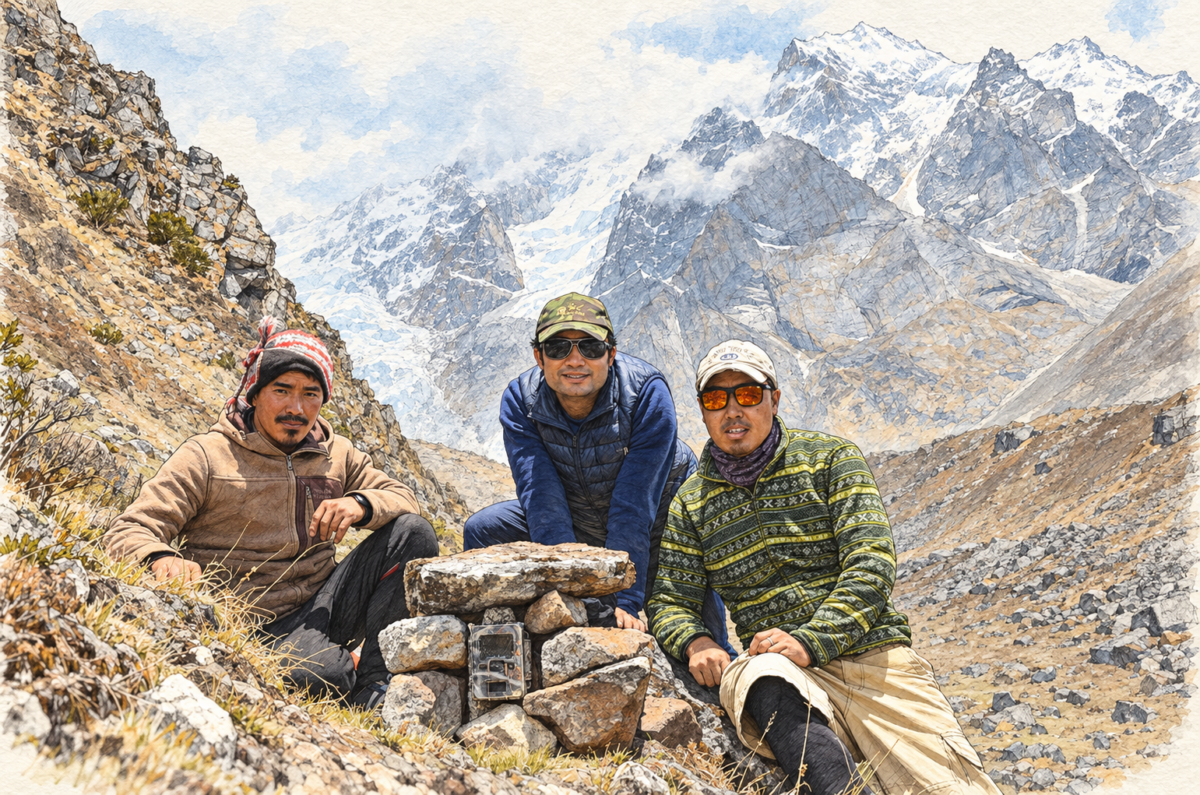
As our research on snow leopard expanded, we began identifying local people who could develop as Snow Leopard Scouts so that we can monitor snow leopard through local people. Buddhi helped us recognize individuals with genuine interest, experience and strong knowledge of the landscape. Prakash and Amrit were among those who showed particular enthusiasm.
They had already supported camera trapping and had spent years moving through snow leopard habitat. They have encountered snow leopard many occasions and had participated in various reconnaissance surveys. Their familiarity with the terrain and their ability to recognize snow leopard and wildlife signs were exceptional.
During a later expedition with wildlife photographers Om Yadav and Sameer Shrestha and our Lead Ranger, Buddhi Gurung, we saw a mother snow leopard with two cubs. Seeing this family in its natural habitat was unforgettable. Our continuing research shows that Khangsar, Tilicho, Gunsang, Yak Kharka and Ledar provide important snow leopard habitat, including breeding areas used by mothers with cubs.
These experiences inspired the idea of creating a place where researchers and visitors could learn about snow leopards while directly supporting conservation and local livelihoods. I discussed this idea with Binod Gurung, local tourism entrepreneurs and the chairs of local Conservation Area Management Committees. We believed that when local communities receive meaningful economic and social benefits from conserving wildlife, they are more likely to value and protect snow leopards.
I committed to providing conservation and technical support through BIOCOS Nepal. Binod Gurung agreed to lead the local coordination and management and to support BIOCOS Nepal’s conservation work through Snow Leopard Haven. This created a partnership connecting scientific research, local knowledge, conservation and responsible tourism.
Snow Leopard Haven is not a zoo, and it cannot guarantee a sighting. It is a knowledge-based lodge and a BIOCOS Nepal field base located within natural snow leopard habitat. Researchers can use it as a base, while visitors can join local scouts to learn about snow leopard monitoring, ecology and coexistence. Local involvement also creates employment and allows communities to receive direct benefits from conservation.
More than finding a snow leopard
My journey with the snow leopard began with curiosity and excitement. Over time, it became much more than searching for a rare animal.
It became a journey of understanding mountain livelihoods, livestock losses, local knowledge, scientific research and the importance of trust. It taught me that conservation is not only about protecting wildlife. It is also about listening to the people who live with wildlife and helping them become leaders in its protection.
The future of the snow leopard in Manang will depend on science, community stewardship and practical action working together. This is the idea behind our Snow Leopard Stewardship Programme and Snow Leopard Haven.
For me, the greatest achievement is not simply seeing a snow leopard in the wild. It is seeing local people, researchers and conservation partners working together to ensure that this magnificent animal continues to live freely in the mountains of Nepal.