

A field journey through the territory of Red panda
Larisha Gautam| BIOCOS-Nepal
It was only latrine (a small pile of scats) beneath the forest canopy, but for us, it was the first message from an animal we had travelled so far to find. The red panda remained hidden somewhere in the forests of Jaljala, yet the sign before us confirmed that we were following the right trail.
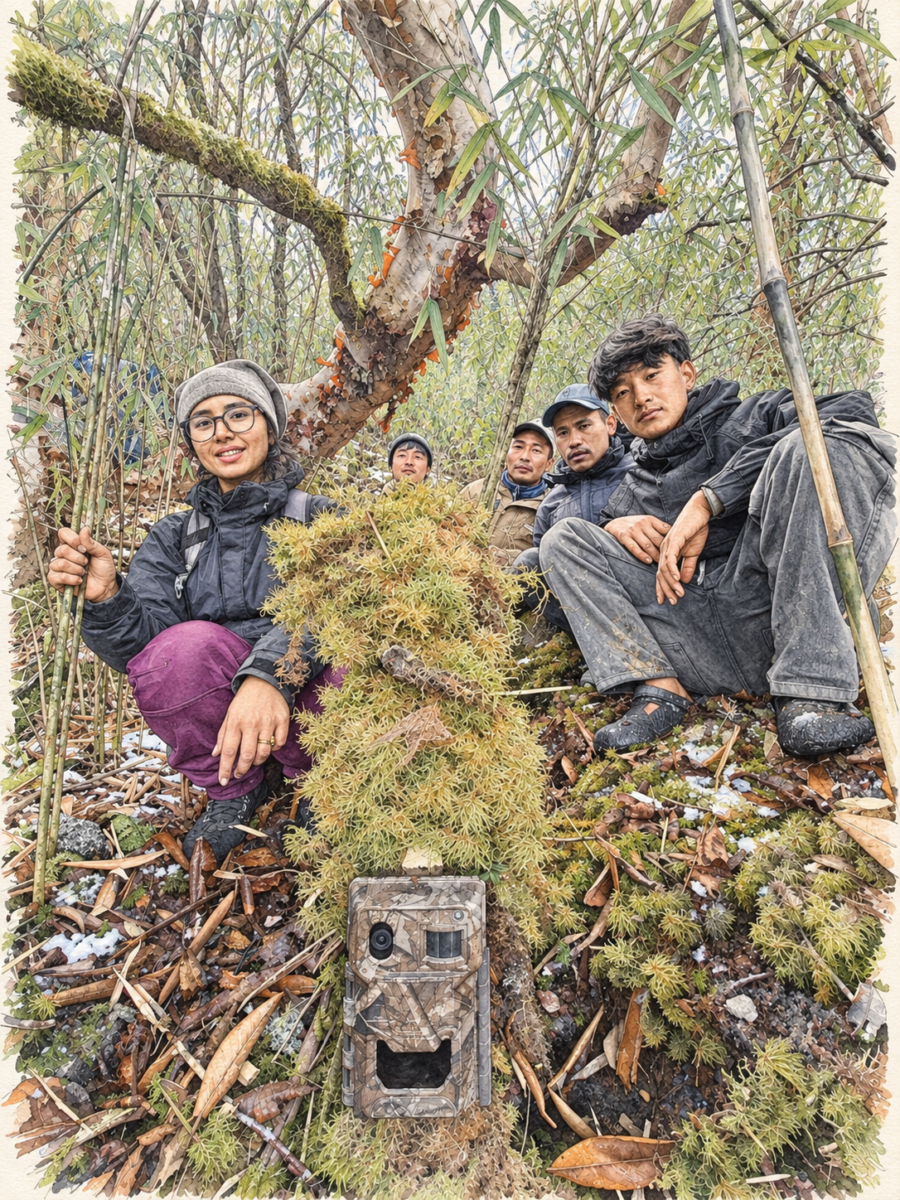
Our field journey began in Kathmandu. Accompanied by Budhi Gurung and Pawan Rai, I travelled by jeep through Kathmandu to Muna. From there, the road ended and we continued on foot towards Jaljala. Our fieldwork focused on collecting Red Panda fecal samples, assessing habitat conditions and human pressures, and installing camera traps at selected latrine sites.
As we walked farther into the mountains, settlements gradually disappeared behind us. They were replaced by steep slopes, dense forests and open Himalayan landscapes. The weather changed without warning. Rain was followed by hailstorms, and snowfall covered parts of the forest. The steep, slippery trails required careful steps, but the beauty of the landscape kept us moving. Mist passed between the trees, snow rested on the forest floor, and the silence made every sound feel significant.
Then we found the first red panda scat.
Finding animal scat may not sound extraordinary, but for us, it confirmed that a red panda had used the area. Red panda latrine sites are valuable sources of information, helping individuals mark their territory and communicate with other red pandas.. Although the animal itself remained unseen, its presence suddenly felt real. As we continued searching, we discovered feeding signs, pugmarks and latrine sites. A partially eaten bamboo stem indicated where a red panda had fed, while a pugmark revealed where it had walked.
The red panda was hidden, but it was no longer absent.
Local residents and herders played an important role in our search. Some accompanied us because they knew the forests, trails and places where red pandas were likely to occur. Their understanding of the landscape came from years of living close to the forest. With their guidance, places that might have appeared ordinary to us became meaningful.
We carefully collected red panda scat for gastrointestinal parasite research and recorded information about the surrounding vegetation, habitat and signs of human activity. Camera traps were also installed at selected latrine sites to continue recording red panda activity after we had left.
While walking from Jaljala towards Gurjaghat, we passed through an area affected by a forest fire many years earlier. The marks left on the landscape contrasted sharply with the healthier forest around it. Seeing this area made the threats to red panda habitat feel more immediate. A forest fire does not only burn trees; it can also damage the food and shelter upon which wildlife depends.
After collecting samples from Gurjaghat, we travelled by jeep at night towards Syalphake in Dhorpatan Hunting Reserve. The mountains disappeared into darkness as the jeep jolted along the narrow and bumpy road. Despite the discomfort, travelling through the mountains at night became one of the memorable parts of the visit.
Before beginning our work inside Dhorpatan Hunting Reserve, we met with reserve staff and presented our research permission. We also discussed red pandas, the threats they face and the importance of protecting their habitat. The conversation reminded me that wildlife conservation depends on cooperation among researchers, reserve authorities, conservation organizations and local communities.
From Syalphake, we continued walking towards Neseldhor. This part of the journey offered some of the most beautiful scenes of the visit. Horses grazed peacefully across the grasslands, while herders guided their sheep through the mountains. After the difficult trails and unpredictable weather, these quiet scenes allowed us to appreciate the close connection between people, livestock and the Himalayan landscape.
The mountains also rewarded us with unexpected wildlife encounters. A flash of colour revealed a Himalayan Monal; Nepal’s national bird, locally known as the Danphe. It was my first time seeing one in the wild. After spending hours watching the ground for scat and pugmarks, seeing these birds brought a different kind of excitement. We also encountered Koklass Pheasant, Himalayan tahr, blue sheep, leopard pugmarks and signs left by several other wild animals. Each discovery made the landscape feel more alive.
Throughout the journey, we hoped that the next turn in the trail might reveal a red panda sitting on a tree branch or moving quietly through the bamboo.
That moment never came.
By the end of the field visit, however, I understood that the experience was not incomplete. The red panda had been present throughout, in the scat we collected, the feeding signs among the bamboo, the pugmarks along the trails and the camera traps waiting beside its latrines.
The journey taught me that conservation often begins with learning to value what remains unseen. Protecting red pandas means conserving the forests, bamboo and connected landscapes on which they depend. It also requires recognizing local knowledge and strengthening cooperation among everyone who shares responsibility for these mountains.
We entered the mountains searching for the red panda.
We left knowing that, although it had remained hidden, it had guided our entire journey.